


wow
The Cudsong Brothers
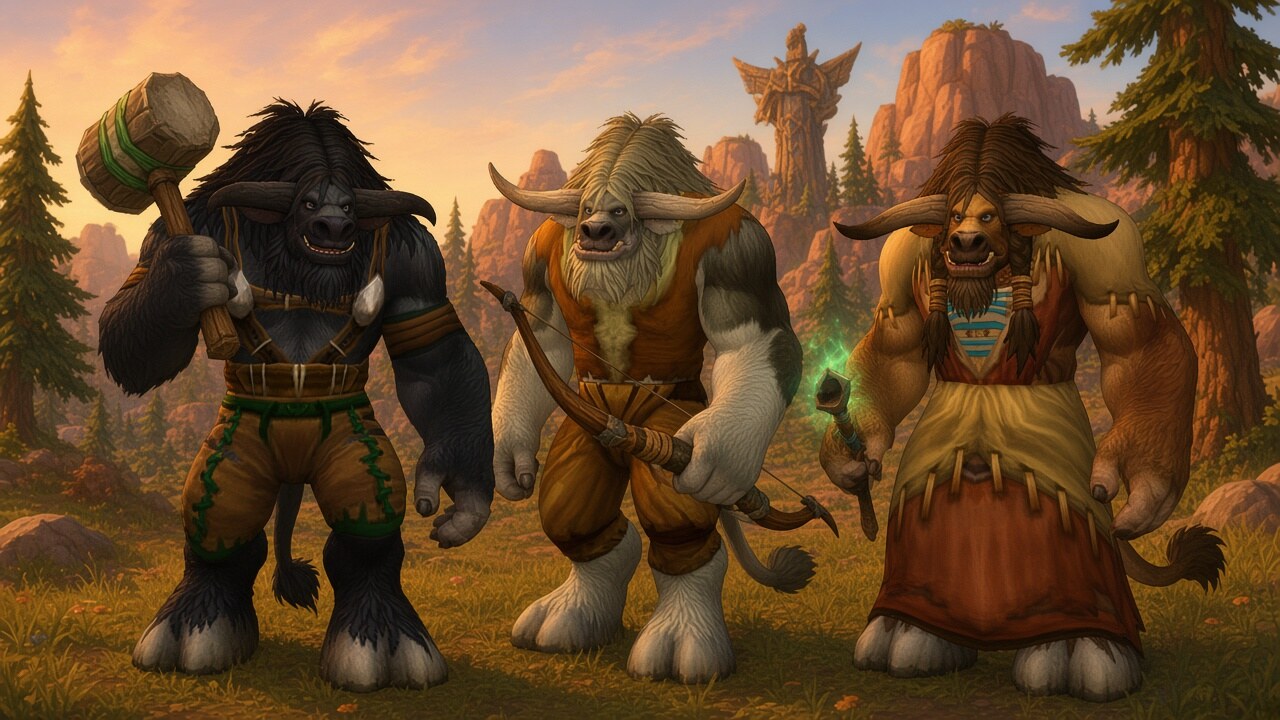
Every night since the long walk out of the Barrens, somebody in the Cudsong family has sung to the kodo.
Not loudly, and not always well. But every night on the grass below Bloodhoof Village, when An’she has gone down behind the mesas and Mu’sha has opened her pale eye over Mulgore, a Cudsong sits on an upturned water bucket and sings low to the herd. The great beasts fold their legs, settle into the grass and chew over the day, and the song rolls over them like a blanket. The chronicler has heard it. It is the kind of music that keeps several tons of nervous animal from deciding, in the dark, that the plains wolves are closer than they are.
This is the story of three calves raised beside that song, and how they came to walk up the road to Camp Narache with a hammer, a bow and a great many questions.
The song on the trek
Before Mulgore, the tauren had no home that stayed put. They followed the herds across the Barrens, and the centaur followed them. The Kolkar raided by night and by day, and every season there were fewer tauren around the fires.
Grandmother Ohsa was already a grandmother then, a white-and-grey herd-keeper with a voice like a slow river. On the worst night of the trek, when Kolkar riders came howling out of the dark and the kodo began to bellow and pull at their tethers, she did the only thing she knew how to do. She climbed onto the lead cart and sang the old grazing songs, the ones calves learn before they learn to walk, and she kept singing while the warriors fought at the edge of the firelight. The herd did not stampede. The carts did not overturn. In the morning the warriors found the kodo lying in a great circle around Ohsa’s cart, chewing their cud as if nothing at all had happened.
The chronicler has been told by scholars that kodo do not, strictly speaking, chew cud. The scholars were not there. Neither, to be fair, was the chronicler.
“There she is,” somebody said that morning. “The cud-singer.” The family has been Cudsong ever since.
Not long after, the orcs came. Thrall’s Horde stood with Cairne Bloodhoof’s warriors against the centaur and saw the long column safely to Mulgore, where the Earth Mother’s land rises green between the mesas and the wind smells of rain. Cairne raised Thunder Bluff on the high mesa. The Cudsongs, who have never been comfortable anywhere a kodo can’t follow, settled on the plain below Bloodhoof Village. The tauren do not forget who stood beside them on their worst night. Neither do the Cudsongs. To the brothers, the Horde has never been a banner so much as a promise somebody kept.
Three calves, three colors
Tarm Cudsong, the father, is black-furred and broad, a quiet bull who carried a spear on the trek and has carried a pitchfork ever since, and much prefers the pitchfork. Sahala, the mother, is a warm tan-brown, with braids she has worn since she was a girl and a laugh you can hear from the next field. She keeps the song now, most nights, though Ohsa still takes a turn when the sky is clear.
They had three sons, and Bloodhoof Village likes to say each calf took his color from a different branch of the family, as if the Earth Mother wanted to be fair about it. The eldest rode into Mulgore as a calf in the back of a kodo cart, black as his father. The middle son was born on the trek itself, under an open sky between one camp and the next, white and grey like his grandmother. The youngest was born in Mulgore after the walking was over, tan-brown like his mother, and he is the only one of the three who has never known anything but home.
How Tohmak became Haymaker
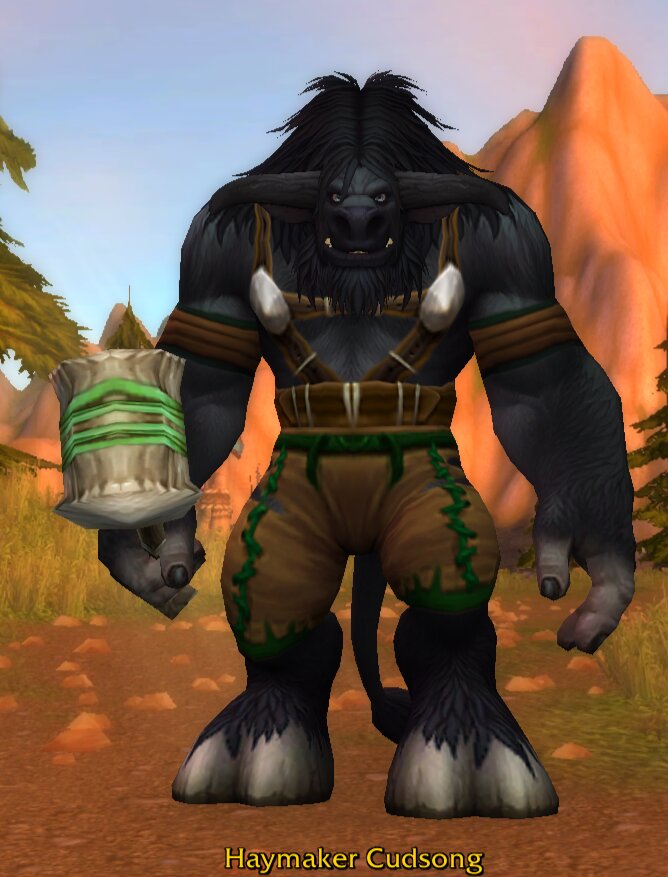
The eldest was named Tohmak, which means something close to “stands firm” in the old herd tongue. He grew up the way a mesa does: slowly, and then all at once. By his twelfth summer he was cutting hay beside his father in the grass below Bloodhoof Village. By his fifteenth he was doing it faster than his father, and more of it, with considerably less care about where the hay ended up. “Tohmak makes hay” became a village saying for doing a great deal of work all at once and leaving someone else to tidy up after. Before long it was just Haymaker, said with a fond shake of the head.
The name got its second meaning one autumn, when a Bristleback raiding party crept up out of Brambleblade Ravine to help themselves to the winter stores. Haymaker was alone at the stacks with the big wooden mallet he used for driving fence posts. The first quilboar to reach him took one wide, honest swing to the side of the head and woke up the next morning under a haystack, with all his tusks and no memory of the afternoon. The rest of the party decided the hay was not worth it. Ever since, when anyone in Bloodhoof Village says Haymaker, they mean the swing as much as the harvest, and he lets them.
He still carries that mallet. The green bands around its head were wrapped there by his mother when the wood began to split, and he will not let anyone replace them. He wears a leather harness hung with two white tusks, which he says are trophies from that afternoon. His mother says he found them in the ravine a week later.
How Kahnu became Bullseye
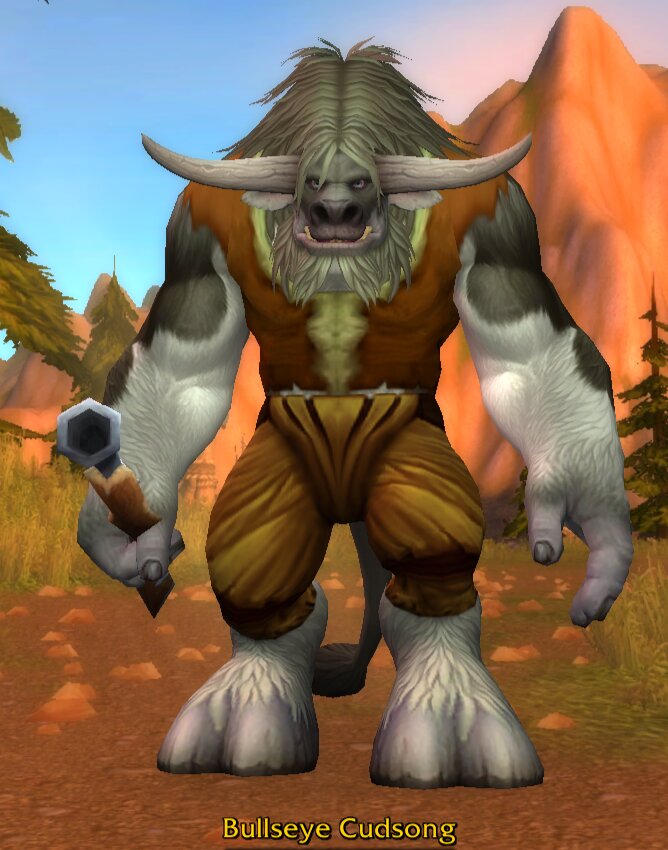
The middle son was named Kahnu, after the soft rain that came the morning he was born, the first rain the column had seen in weeks. He was a quiet calf with a long, steady stare. He could watch a hawk from the moment it left the mesa until it dropped onto a field mouse half a league away, and never once blink.
His nickname came from his big brother, by way of his big brother’s forehead. When Kahnu was seven, and Tohmak was a good deal older and much too pleased about it, Tohmak spent an afternoon teasing him from the far side of the kodo pen. Kahnu said nothing. He picked up a smooth round pebble, walked off across the pasture until he was so far away that Tohmak could no longer see him, turned, and threw. The pebble came down out of the sky and struck Tohmak square between the eyes. He sat down in the grass to think about it.
Grandmother Ohsa had watched the whole thing, and laughed so hard she had to hold onto the fence. “Right in the bull’s eye,” she said, and that was that. Kahnu has been Bullseye ever since, and Haymaker, to his credit, was the first to call him by it, once his head stopped ringing.
The chronicler notes that between them, the two nicknames hold the whole Cudsong philosophy of conflict. One brother walks up and settles it. The other settles it from a long way off, before anyone knew there was a problem.
Bullseye spent the rest of his youth proving the pebble was not luck. He ran the plains with the herd scouts, learned the tracks of every plainstrider and prairie wolf between Red Cloud Mesa and the Venture Company’s noisy camps, and practiced with a short bow until the targets ran out of eyes. He wears an orange-brown vest his mother made him, and keeps a small hex-headed hammer at his belt for driving tent stakes, which he insists is a hunting tool.
Why Ruminant kept his name
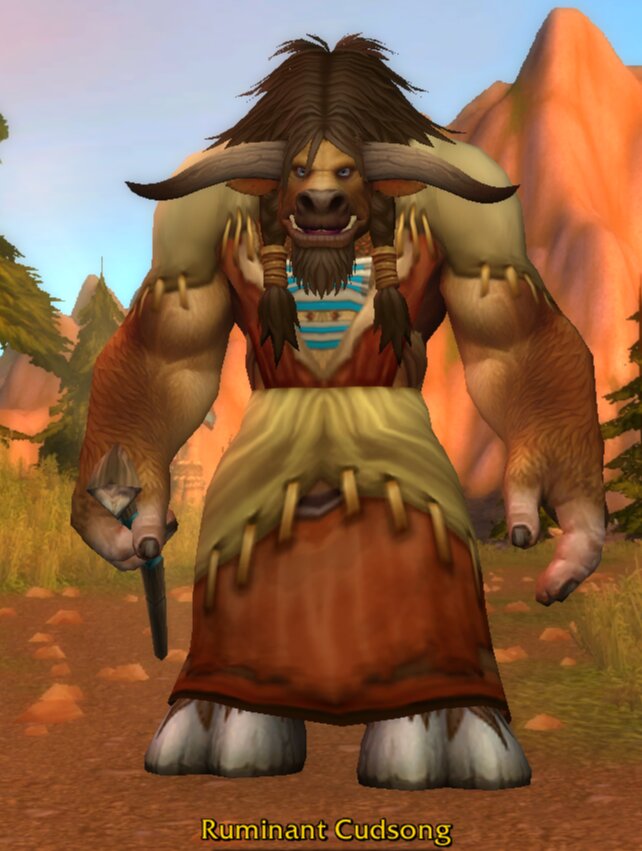
Ruminant is the only brother still called by the name he was given, because he earned it before he could walk. As a calf he would sit in the grass among the resting kodo, chewing a stem of wild grass and looking at nothing at all for an hour at a time. Ohsa took one look at him and said he was ruminating, and the name came with a sense of humor already attached.
He grew into it. Ask Ruminant a question and he will answer it, eventually, after turning it over a few more times than anyone else would. He would tell you he’s just chewing things over. He braids his long brown hair and his beard with beads, the way his mother does, and wears a red and khaki robe with a fringe of claws along its edge and a blue-striped shirt beneath. He carries a small knife, which he uses for cutting herbs and, so far, for nothing else.
The hammer, the bow and the grove
So why did one become a warrior, one a hunter, and one wander so far off as to become a druid?
Haymaker’s answer is the simplest. Tarm Cudsong carried a spear on the trek because somebody had to, and he came home from the centaur wars hoping never to pick it up again. Haymaker grew up hearing the stories his father would not tell, and decided early that if anyone in the family ever had to stand between the herd and the dark again, it would be him, so that nobody else would have to. To Haymaker, a warrior is not a bull who wants a fight. He is a fence post. He goes into the ground where the trouble will come, and he does not move. That he enjoys the swinging part is, he admits, a happy accident.
Bullseye’s answer is the land. The tauren are hunters as much as herders, and the old hunt in Mulgore is a kind of prayer: take only what you need, thank the Earth Mother for it, waste nothing. Bullseye loves the open plains more than anything with a roof, likes animals better than most people, and has always preferred to solve a problem before it gets close enough to breathe on him. He means to find a companion out there, some beast that will walk beside him by choice. He says he will know it when it stares back.
Ruminant’s answer is the long one. For as long as anyone could remember, the tauren had kept the Earth Mother’s ways through their shamans and the old rites. The path of the druid had been lost to them for generations. Then Hamuul Runetotem went far to the north and learned it again from the night elves, of all people, and from the demigod Cenarius himself. He came home to Thunder Bluff an Arch Druid and opened his teaching on Elder Rise. Some elders were glad. Others, and the Grimtotem loudest among them, grumbled that a tauren had no business learning the Earth Mother’s ways from elves who stand with the Alliance.
Ruminant heard the grumbling, chewed it over for most of a year, and then rode the long lift up to Elder Rise to listen to Hamuul for himself. What he heard there was not an elven idea or a tauren one. It was that the land belongs to no side. That tauren and night elves of the Cenarion Circle sit together in Moonglade under the same moon and tend the same world, and that a druid’s work is to help keep it whole. Ruminant came home and told his family he meant to walk farther from home than any Cudsong since the trek, and that one day the road would take him all the way to Moonglade.
His mother cried a little. His grandmother said she had been waiting years for one of them to say something interesting. His father said nothing for a long while, and then asked whether druids still had to help with the milking. They do. Ruminant went anyway.
The chronicler suspects the family is prouder of this than it lets on. The Cudsongs have always been the ones who keep the herd together on a bad night. Ruminant simply decided the herd was bigger than he had been told.
The road to Camp Narache
They set out together before dawn, on the road up to Red Cloud Mesa, where Chief Hawkwind keeps Camp Narache and young tauren go to be tested before the world is allowed to have them. They took almost nothing. Haymaker had his mallet and his harness. Bullseye had his vest, his little hammer and a pocket full of smooth round pebbles, for old times’ sake. Ruminant had his knife, his braids and a great many unanswered questions. Their roads will not always run side by side, and Ruminant’s, the chronicler hears, runs through rougher country than his brothers’. That is a worry for another day.
Their mother sang them as far as the edge of the pasture. The kodo, who have never once been told anything, stood up and watched them go.
Three brothers. A warrior who goes where the trouble is, a hunter who meets it a long way out, and a druid who would like to understand it before anybody has to swing at anything. The chronicler has seen worse families set out with better gear, and most of them did not get far. These three have the song.
The plainstriders on the mesa have no idea what is coming. Neither do the Bristleback. Neither, the chronicler suspects, do the brothers.